We're living in a new age of sense of agency
 Marius Hanganu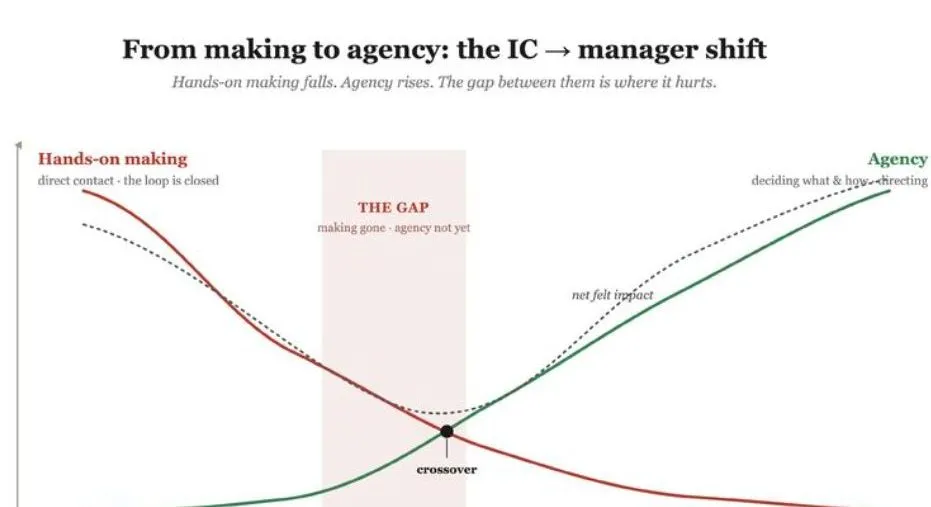
We’re living in a new age of sense of agency.
LLMs have quietly promoted everyone into management. You no longer make the thing yourself, but rather you delegate, wait, review and approve. This supervision comes with the psychological cost of breaking of flow - the topic of my last post.
Nobody applied for this promotion. The developer who used to write every line now reviews diffs produced by an agent. The analyst who used to build the model now checks the one the agent built. Paul Graham described the two clocks in 2009: makers prefer to use time in units of half a day at least, while on the manager’s schedule you change what you are doing every hour. Working with agents moves you onto the second clock. A job every few minutes, a review, a correction, then the next job.
Two kinds of reward
A manager’s job is fragmented and value is often produced through other people, across parallel work threads. The individual contributor has a cleaner psychological reward since the thing exists in front of their eyes.
You wrote the function, it runs, and you can point at it. A manager rarely gets that moment. The result is a team that ships better than it did a year ago, and the credit for it is shared.
The reward for a manager is slower and probably more diffuse and it comes through the system they shaped or the team they improved. But it’s driven by a proactive stance, and while we may lose some flow in the age of AI, we gain more agency.
But it’s driven by a proactive stance, and while we may lose some flow in the age of AI, we gain more agency.
Psychology has a name for this second kind of control. Albert Bandura’s agentic theory distinguishes three modes of agency: direct personal agency, proxy agency, where you rely on others to act on your behalf, and collective agency, exercised through coordinated effort. The maker works mostly in the first mode. With agents, more of the day moves into the second, and the proxy is software.
The valley in between
The shift does not feel good right away. The chart in the original post has five stages: Maker, Handoff, Valley, Reframe, Manager. In the Valley, the maker’s reward is gone and the manager’s has not arrived. The Reframe comes when the goal, the constraints and the definition of “good enough” start to count as your work.
People who moved into management before know this dip. Linda Hill of Harvard Business School studied star performers becoming managers for over a decade. In her HBR piece she writes that most new managers initially fail “because of a set of common misconceptions about what it means to be in charge.” With agents, many of us are new managers at once. The difference is that the IC gets the leverage without the title or the headcount.
And this is good news for the IC in all of us.
A shorter version of this piece first appeared on LinkedIn. Join the discussion there.

Marius Hanganu
Software engineer and co-founder of Tremend. He writes about AI agents, management in the age of AI and the digital euro.
§Comments